 Section 1
 Index Page
 Lab Reports Index
2. Equipment Operation
2.1 DMV COFDM Equipment
The DMV system 3000 modulation equipment consists of a 19 inch rack frame housing a 12 rack unit modulator, two redundant 4 rack unit multiplexers and two 6 rack unit MPEG encoders (top to bottom in Picture 1). The encoders and multiplexer are controlled via a 10 base-T ethernet connection to the Multiplex Control Computer (MCC). The MCC communicates directly with the multiplexer which in turn relays information destined for the MPEG coders via the 9 pin D-type RS-422 data cables (Taxi Cables). The multiplexer passes the data multiplex to the Coded Orthogonal Frequency Division Multiplex (COFDM) modulator via a RS-422 cable. The multiplex data is asynchronous to the modulator output data rate. The modulator bit stuffs data to achieve a constant data rate on the modulated COFDM output.
The system 3000 modulator uses a 2K IFFT (Inverse Fast Fourier Transform) to produce a COFDM signal with 1705 carriers in a 7 MHz channel. To generate the signal it uses 32 parallel DSP engines mounted on the 4 identical centre boards visible in Picture 2.
|
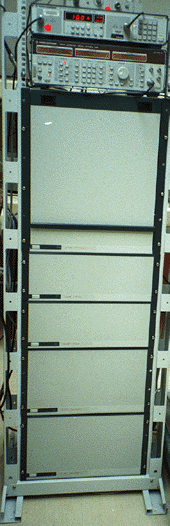
Picture 1 - DMV
Equipment Rack
|
| The modulator is a modified version of the 8 MHz system being used in Europe that has had its system clock rate (36.56 MHz) increased by 7/8 ths (41.78 MHz). It generates an IF centred on 35.3 MHz that is 6.67 MHz wide at around 0 dBm. An internal high level mixer and amplifier allows an external local oscillator at 0 dBm to be applied to mix the signal to VHF or UHF frequencies. Communication and control of the modulator is via a 9600 baud RS-232 data connection to a VT-100 ANSI terminal. This arrangement allows re-configuration of the modulator system parameters such as modulation type, Forward Error Correction (FEC), Guard interval and data source. The modulator can be configured to produce a 2^23-1 pseudo random data stream for BER measurement or to use the external data from the multiplexer in the picture transmission mode.
|
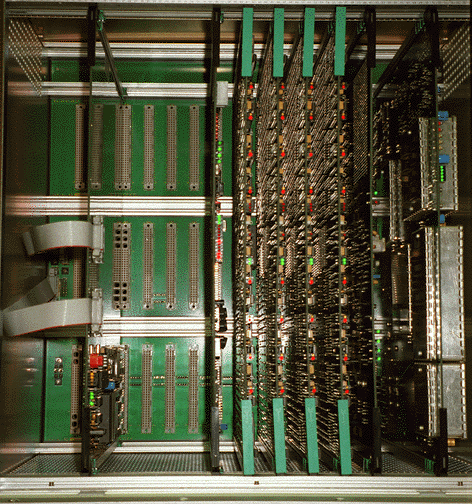
Picture 2 - COFDM Modulator
|
The MCC provides (Picture 3) comprehensive control of the multiplex components and System Information (SI) data streams. Analogue, Serial or Parallel digital inputs for each MPEG coder are selectable along with the desired data rate for each of the stream components. The MCC monitors alarms and allows re-configuration of the multiplex to a real time schedule. It is a PC running a SunOS Unix Kernel
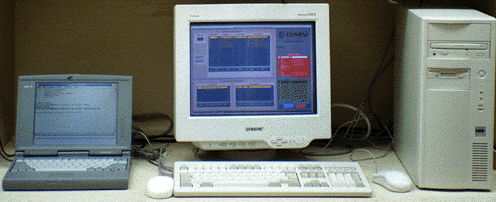 Picture 3 - Laptop for Modulator Control and MCC for Multiplex Control
The system 3000 professional receiver is housed in a 2 rack unit box that contains a COFDM demodulator covering the VHF and UHF bands plus an integral Pace MPEG-2 decoder. Picture 4 shows the back and front view of the commercial COFDM receivers that were tested.
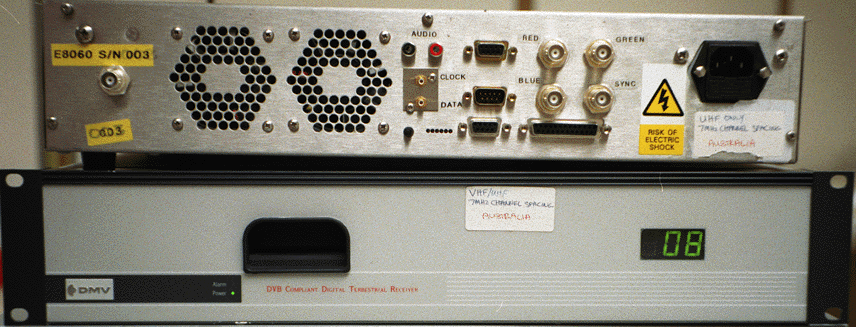 Picture 4 - DMV System 3000 DVB-T COFDM Receiver
The receiver was fitted with a Philips tuner front-end optimised for VHF and offers control via IR remote and an RS232 interface. The Pace MPEG board passes parameters such as channel number and guard interval to the COFDM decoder and is able to monitor the basic viterbi error rate information. All user information except channel number is presented as on screen displays. The receiver provides RGB and Sync/PAL video outputs and has a single 75W
BNC RF antenna input connector. A 25 pin D-Type female connector is provided for a LVDS transport stream output that allows a number of separate decoders to simultaneously access multiple services within the transport stream. The test unit also has two SMB connectors feeding out TTL clock and data for the BER meter. The BER data is tapped off before the reed solomon decoder. This allows measurement of the DVB Quasi Error Free (QEF) error rate defined in the DVB specification as
2.1x10⁻⁴ errors. The QEF point is the error rate where the reed solomon code reaches the limit of its correction ability for white noise degradation. The COFDM decoder board has a number of red alarm LEDs at the rear of the unit that indicate various levels of unlock and timing acquisition. A single alarm led on the front panel indicates that the COFDM decoder board is experiencing errors or is unable to decode the RF signal.
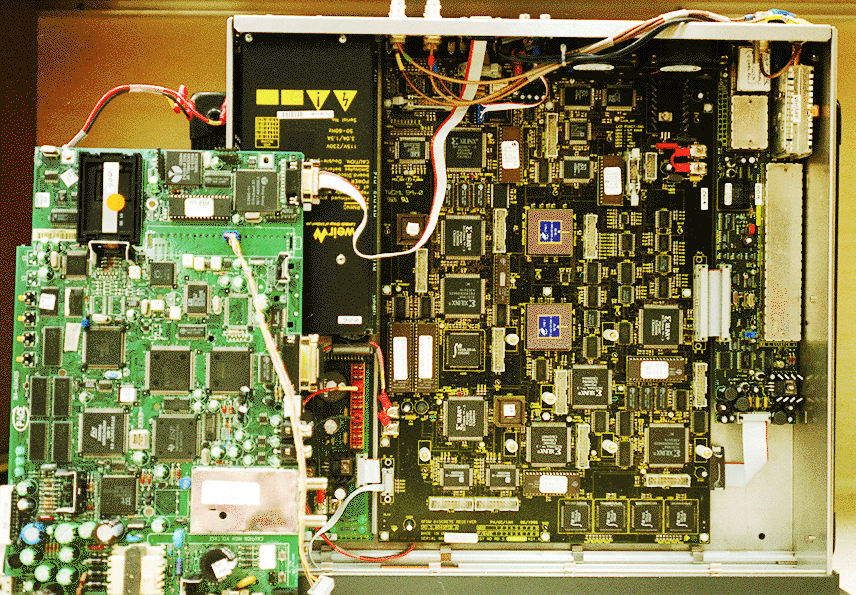 Picture 5 - The System 3000 Professional COFDM Receiver
Picture 5 shows the internal boards contained within the DMV receiver. To the left is the Pace MPEG decoder that normally sits over the large discrete COFDM demodulator board. To the right is the tuner board that accommodates the RF front end, synthesiser and A/D converter. Some of the hardware on the Pace decoder such as the power supply, smart card and RF output are not being used. The COFDM demodulator and tuner boards have now been reduced to a set of 3 or 4 chips. This photograph was taken during the software upgrade when the unit was disassembled to change the interleaver EPROM.
2.2 Zenith/Harris 8-VSB Equipment
The Zenith 8-VSB equipment is generally referred to as the "Blue Racks" and comprise a half height 19 inch rack for each modulator and receiver. The Zenith modulator generates a 44 MHz IF signal and has an onboard synthesiser and cable TV type upconverter to produce VHF and UHF signals. It can be switched to various internal data sequences such as all zero, random data and the 2^23-1 pseudo random sequence.
|
The Harris CD-1 modulator (Picture 6) is housed in a transmitter rack module containing three 19 inch sliding equipment trays. These trays house the 8-VSB data modulator, up-converter - correction and power supply respectively. The unit generates the 8-VSB signal at a baseband of 10.7 MHz with a bandwidth of 5.3 MHz. Data can be supplied via a BNC serial connector, although this input was not used during the tests. Without a data input, the modulator generates a 2^23-1 pseudo random data stream for BER measurement similar to the COFDM equipment. As no video hardware was supplied with the 8-VSB system (MPEG HD encoder and decoder) all tests were done using the pseudo random data stream. The pseudo random data stream is generated at the transport stream input to the equipment and so is subjected to the full gamut of reed solomon and viterbi error correction within the system. This means that the output BER, for the threshold of visibility system failure point, is 3x10⁻⁶. The 10.7 MHz baseband signal is fed to the IF upconverter and becomes a 44.0 MHz IF at the output of the modulator. |
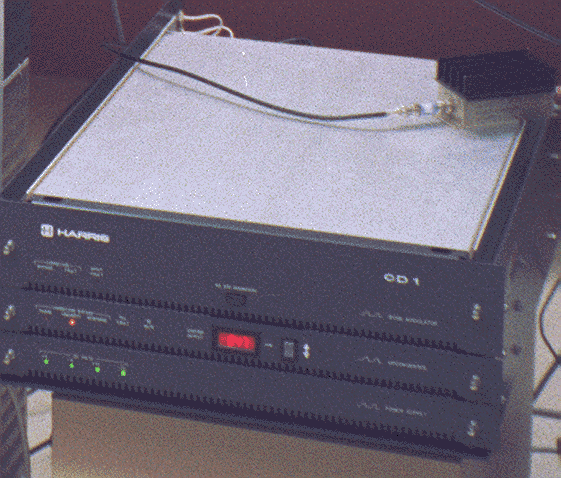
Picture 6 - Harris CD-1 8-VSB Modulator
|
The CD-1 modulator incorporates Linear and non-linear correctors into the up-converter to pre-correct for downstream transmission system impairments. The transmitters also incorporate these correctors. As these correctors pre-distort the spectrum to make up for exciter, PA and antenna system problems it was decided they were not necessary for the laboratory testing. During the testing the 8-VSB signal was switched between various transmitter and rig signal routing configurations. Online readjustment of these corrector settings was not allowed during the measurements as this could skew the results. These correctors were switched out during the 8-VSB laboratory testing leaving the 8-VSB modulator making a flat 44 MHz IF spectrum..
|
The Zenith ATSC receiver consisted of a blue card rack with 14 cards installed (Picture 7 and Picture 8). A single N-Type 50W
unearthed RF input was provided with switching for channel number and frequency offset on the front panel. The rear panel provided a serial interface for communication with the system cards via a laptop computer, a 37 pin D-Type female connector for Grand Alliance data output and BNC connectors for TTL BER clock & data. The front of the rack was open revealing many led indicators showing the status of the various parts of the system. When the system has locked on to a signal and working correctly the majority of the LEDs are green. On the right side of the card rack a LED display reads out the Segment error rate.
|
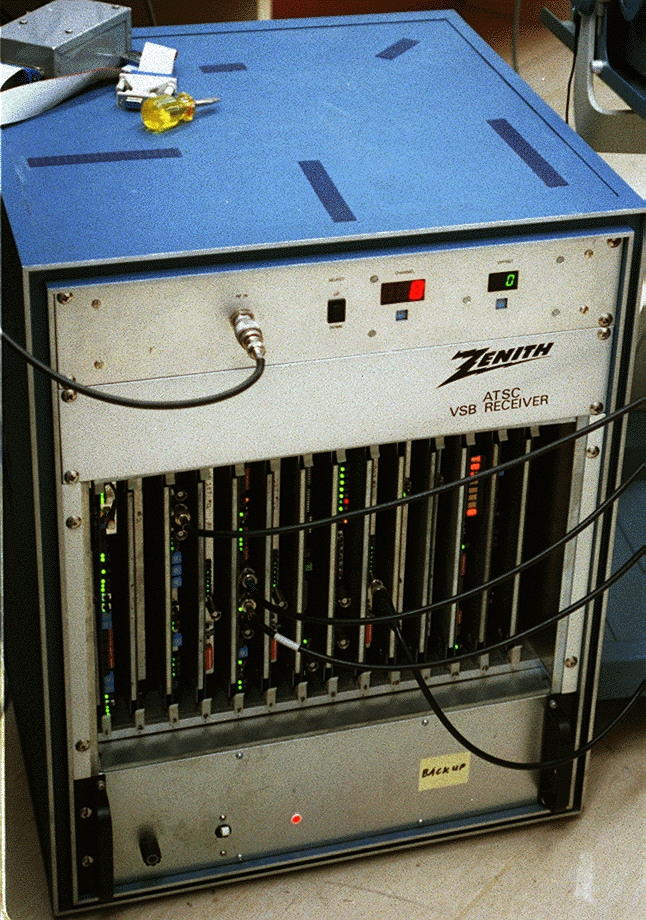
Picture 7 - ATSC 8-VSB Receiver Rack
|
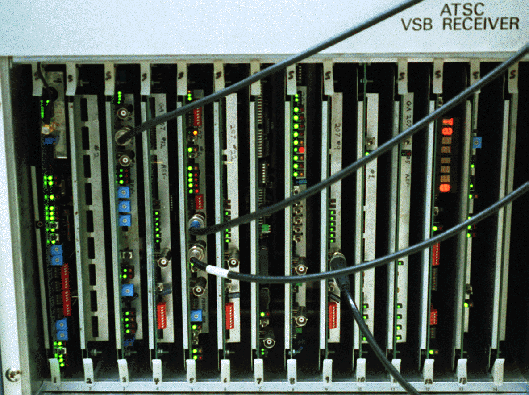
Picture 8 - ATSC 8-VSB Card Rack
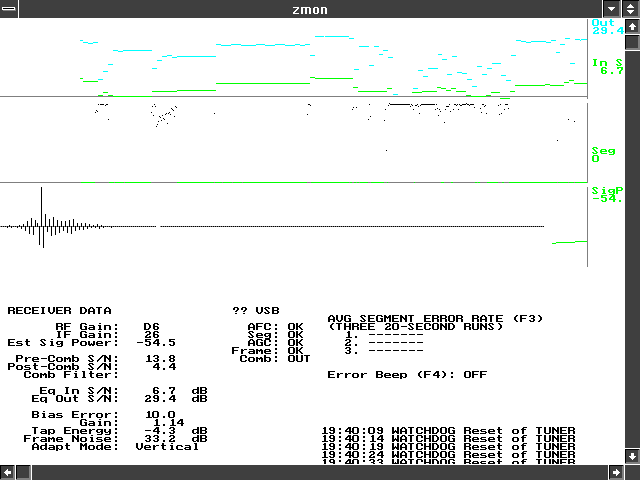
Picture 9 - ZMON 8-VSB Demodulation Monitor Program
The serial interface on the back of the receiver was used to interface a laptop PC for monitoring the state of the demodulator and equaliser. Picture 9 is a screen capture of the ZMON program that reads out the real time system performance parameters. The key parameter was the S/N out of the equaliser. If this number was less than 20 dB then the system was finding the signal difficult to demodulate. Facilities are provided to measure three 20 second periods for segment errors, and a graphical display of the equaliser taps is presented. Picture 9 shows a real on air echoed environment.
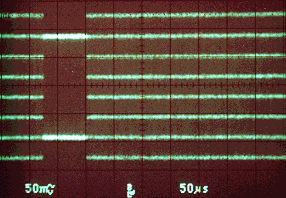
The cables that can be seen connected to the front of the card frame in Picture 8 are used to provide a data constellation type display on an analog CRO. This CRO is triggered at segment rate (equivalent to PAL line rate) to display the segment sync and 188 byte data segments, or at Frame sync rate (equivalent to PAL Field Rate) to display the Frame Sync every 24.5 ms.
Picture 10 and Picture 11 show the segment sync before and after the receive equaliser with an unimpaired 11 mV input signal. Similarly Picture 12 and Picture 13 show the data at Frame rate with no impairment. The two level pseudo random data contained within the frame sync is used as a training sequence by the receiver equaliser to compensate for channel signal impairments.
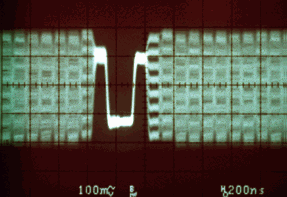 Picture 10 - 8-VSB Segment Sync Before Equaliser - No Impairment
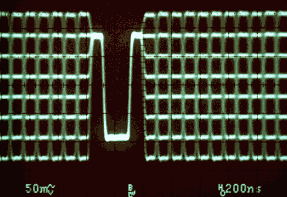 Picture 11 - 8-VSB Segment Sync After Equaliser - No Impairment
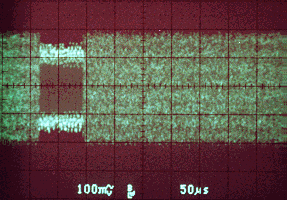 Picture 12 - 8-VSB Frame Sync Before Equaliser - No Impairment
 Picture 13 - 8-VSB Frame Sync After Equaliser - No Impairment
Picture 14 and Picture 15 show the Frame sync with the system operating at a C/N threshold of 14.3 dB. The equaliser is unable to restore the data eye sufficiently and so the system produces errors in the data due to no data eye.
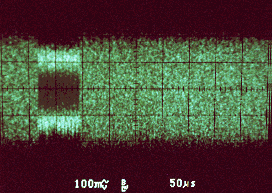 Picture 14 - 8-VSB Frame Sync Before Equaliser - At C/N Threshold
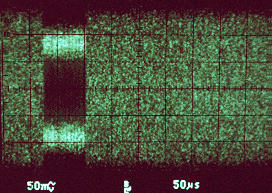 Picture 15 - 8-VSB Frame Sync After Equaliser - At C/N Threshold
Note: Segment syncs occur in the place of the first byte of the 188 byte MPEG packet and are the digital equivalent of line syncs in PAL television. Similarly digital Frame syncs occur at a 24.5 ms rate and are analogous to the PAL vertical blanking interval
2.3 Transmission Equipment
Two transmitters were loaned to the specialists' group for generating real transmissions of digital television. These transmitters were supplied by NEC Australia and Comsys. They were used during the laboratory testing to provide a real indication of the digital system typical real transmission performance and to transmit high level signals into the echo delay systems. The laboratory testing of these transmitters was not intended as a comparison of the transmitter manufacturers' performance as the tests sought to define typical equipment operation and not an ultimate one off performance. Picture 18 shows the two transmitters set up in the main laboratory shielded area net to the echo combination attenuators.
NEC Australia supplied a NEC PCN-16R2D 200 Watt DTTB transmitter. This transmitter had originally been designed as a 1.25 kW analog PAL vision transmitter that was then modified for COFDM service as a VHF Digital Radio Broadcasting transmitter. The DTTB model is a further evolution and re-marking of the equipment for Digital Television at the 200 Watt level. The transmitter was configured for 3 phase 415 volt operation drawing under 2A per phase. The PA is a single broad band amplifier module fed from an exciter containing a LO module (not used), IF up converter and pre-corrector. During the first COFDM demonstration in November 1996 the exciter was aligned for VHF channel 8 operation. These adjustments were not changed during the laboratory testing. To change the frequency of operation this transmitter required the retuning of filters on the upconverter module only. A second pre-tuned upconverter board was supplied by NEC allowed the transmitter to be moved to channel 6 VHF for the field test program.
Comsys supplied a Harris EL-2000 1 kW digital transmitter. This transmitter was a 4 kW analog television transmitter that had been modified for digital operation. The transmitter was configured for single phase operation on 240 Volts @ 50 Hz and drew around 20A from the supply. A total of five 1 kW PA modules are utilised in this device with one acting as a driver for the other four. A coaxial hybrid ring combiner is used to combine the output of the four PAs using tuned length sections for VHF channel 8. The exciter contained an up converter, linear and non linear IF correctors, fixed bandpass filtering and digital power control. The high number of frequency sensitive components in this transmitter caused it to only be used on channel 8 VHF during the Laboratory and Field test programs. During the 8-VSB testing Harris engineers fitted this transmitter with two sets of IF correctors switched by relays. This allowed separate IF pre-correction of the 44 MHz 8-VSB and 35.3 MHz COFDM signals.
 Section 3.1