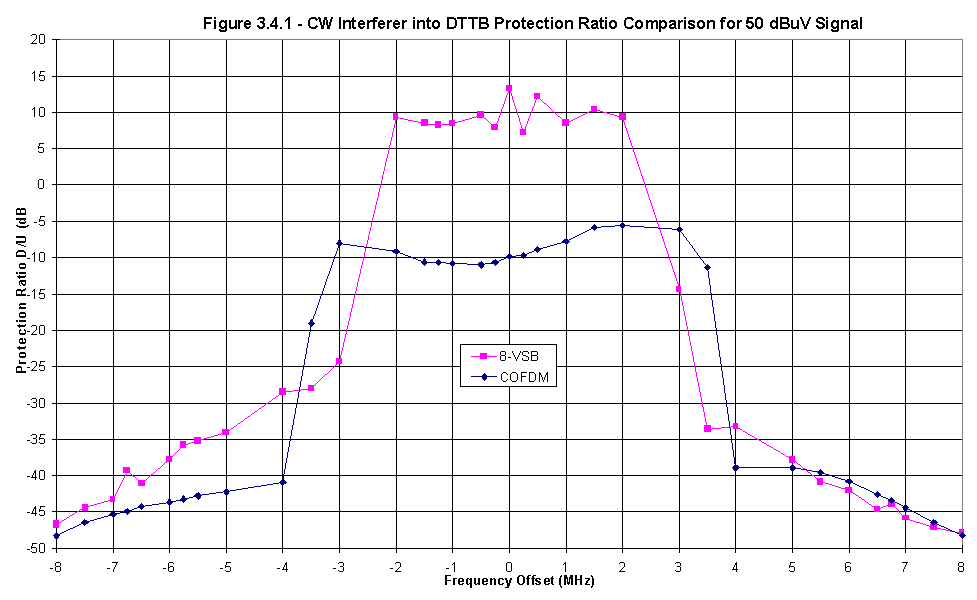
Figure 3.4.1 - CW into DTTB protection for 50 dBuV input
 Section 3.3
 Index Page
 Lab Reports Index
The CW into DTTB interference test was used to determine the effect of a narrow-band interferer within or about the DTTB channel. The SCM signal generator was used to generate an unmodulated CW carrier at various offsets ranging from -8 to +8 MHz about the centre of channel 8.
As the test requirements for this measurement are very similar to the PAL into DTTB measurement the two were conducted simultaneously. The PAL signal was switched off using its LO generator and the CW was switched on by setting the output level of the SCM signal generator. The test procedure is covered in the PAL into DTTB test method in section 3.3.
An advantage of alternately measuring the CW and PAL interferers, with each DTTB system, was that the equalisers within those systems were forced to readjust to a differing signal type every alternate measurement, and so could not track the test. It is felt that this approach achieved more repeatable results in the presence of adaptive equalisation techniques.
Figure 3.4.1 - CW into DTTB protection for 50 dBuV input
Figure 3.4.1 shows the CW into DTTB protection plot for both modulation systems. The narrow band CW interferer was much more destructive with the 8-VSB system than the COFDM system. A difference of 17 to 23 dB separates the systems with the 8-VSB requiring any interference of this type to be around 10 dB below the digital signal level. The COFDM system could cope with in channel interference to 6 dB over the COFDM power level.
The 8-VSB system showed increased sensitivity around the channel centre due to a beat with the "Nyquist" sampling frequency used in the receiver equaliser.

Figure 3.4.2 - Co-Channel CW into DTTB protection for small frequency offsets
Figure 3.4.2 shows the close in performance of the two DTTB technologies when exposed to a CW interferer. Again the 8-VSB critical equaliser frequencies are evident along with the cyclic COFDM performance which is a direct reflection of the COFDM systems orthogonal carrier spacing. When the CW interference falls at the worst location the CW protection is degraded by up to 15 dB with the version 1.0 equaliser. The version 2.1 equaliser was able to reduce this variation to 8 dB.
If a mean value for protection is chosen for COFDM (-2.5 dB) and 8-VSB (+13 dB) at mid channel there is a difference of 15.5 dB between the systems.
Once again the data does not reveal any optimum location for a known CW interferer within the DTTB channel.
Figure 3.4.3 and Figure 3.4.4 compare the performance of each DTTB system when passed through real transmission hardware for CW interference. No clear trend or difference was observed for the COFDM system and apart from additional sensitivity around the centre channel and pilot frequencies the 8-VSB system did not show significant performance degradation. Sensitivity in the region of the pilot increased by 5 dB and around centre channel by 3 dB.
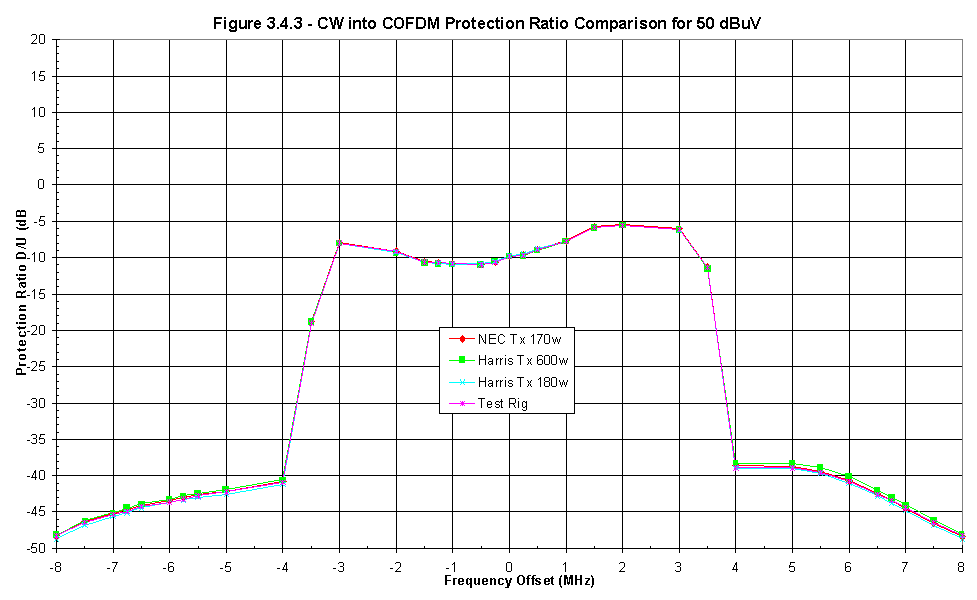
Figure 3.4.3 - CW into COFDM protection for real transmission hardware

Figure 3.4.4 - CW into 8-VSB protection for real transmission hardware
 Section 3.5
Index Page
Lab Reports Index
Section 3.5
Index Page
Lab Reports Index